M
MercyNews
Home
Back
French Kitesurfer Sets World Record During Storm Goretti
Sports

French Kitesurfer Sets World Record During Storm Goretti

Le Figaro2h ago
3 min de lecture
📋

Key Facts

  • ✓ Clément Huot successfully executed a kitesurf jump lasting 13 seconds, a duration that sets a new world standard for the sport.
  • ✓ The athlete reached a maximum altitude of 37 meters during the jump, equivalent to the height of a 12-story building.
  • ✓ The record was achieved during Storm Goretti, utilizing the storm's exceptional wind conditions to facilitate the massive aerial feat.
  • ✓ This achievement marks a significant milestone for the Breton athlete and the global kitesurfing community.

In This Article

  1. Quick Summary
  2. The Record-Breaking Feat
  3. Harnessing the Storm ️
  4. A Milestone for Kitesurfing
  5. Key Takeaways

Quick Summary#

Clément Huot, a kitesurfer from Brittany, has redefined the limits of the sport by setting a new world record. The feat was accomplished during the peak of Storm Goretti, a weather system that provided the perfect, albeit dangerous, conditions for extreme aerial maneuvers.

On Thursday, Huot utilized the storm's powerful winds to launch himself into the air, remaining airborne for an unprecedented duration. This achievement not only showcases his exceptional skill but also highlights the raw power of nature harnessed for athletic performance.

The Record-Breaking Feat#

The specifics of the record are as astonishing as the conditions under which they were achieved. Clément Huot managed to stay in the air for a total of 13 seconds, a duration that is exceptionally long for a kitesurf jump. During this time, he reached a maximum altitude of 37 meters, soaring high above the turbulent water.

This combination of time and height sets a new benchmark for the discipline. To put this into perspective:

  • 13 seconds of continuous airtime is a benchmark in the sport
  • 37 meters is equivalent to jumping from a 12-story building
  • The feat required precise timing and control amidst storm-force winds

The execution of such a maneuver demands not only physical strength but also an intimate understanding of the wind dynamics generated by the storm.

Harnessing the Storm 🌪️#

Storm Goretti provided the necessary fuel for this record attempt. Typically, such weather conditions are avoided by water sports enthusiasts due to safety concerns. However, for an elite athlete like Huot, the exceptional wind conditions were a unique opportunity.

The storm created a specific set of circumstances that allowed for massive jumps:

  • Sustained high wind speeds
  • Consistent gust patterns
  • Low atmospheric pressure

By capitalizing on these elements, Huot transformed a potential hazard into a world-class sporting venue. The success of the attempt underscores the evolving capabilities of modern kitesurfing equipment and the daring nature of its top competitors.

A Milestone for Kitesurfing#

This record represents a significant moment for the kitesurfing community. It pushes the boundaries of what was previously thought possible regarding airtime and altitude. Clément Huot has effectively raised the ceiling for the sport, challenging other athletes to match or exceed his performance.

The achievement brings increased attention to the technical and athletic prowess required in modern kitesurfing. It serves as a testament to the dedication of athletes who train specifically to exploit extreme weather windows for record-setting performances.

The boundaries of the sport are constantly being tested, and this record is a clear demonstration of that evolution.

Key Takeaways#

The record set by Clément Huot is a defining moment in extreme sports history. It highlights the intersection of meteorology, technology, and human skill. The success of this attempt validates the strategy of using storm systems to achieve superlative athletic feats.

Looking forward, the kitesurfing world will undoubtedly analyze the data from this jump to understand the mechanics of such a flight. This event sets a new standard for what constitutes a world-class performance in the discipline.

  • Athlete: Clément Huot (Le Breton)
  • Conditions: Storm Goretti
  • Altitude: 37 meters
  • Duration: 13 seconds
#Voile

Continue scrolling for more

L'IA transforme la recherche et les preuves mathématiques
Technology

L'IA transforme la recherche et les preuves mathématiques

L'intelligence artificielle passe d'une promesse à une réalité en mathématiques. Les modèles d'apprentissage génèrent désormais des théorèmes originaux, forçant une réévaluation de la recherche et de l'enseignement.

Just now
4 min
175
Read Article
How business leaders are responding to Trump's plan to cap credit card interest rates, from JPMorgan to SoFi
Politics

How business leaders are responding to Trump's plan to cap credit card interest rates, from JPMorgan to SoFi

Business leaders like Klarna's CEO support Trump's credit card cap proposal, while major banks and investors warn of risks. BRENDAN SMIALOWSKI/AFP via Getty Images Donald Trump proposes a 10% cap on credit card interest rates starting January 20, 2026. Business leaders like Klarna's CEO support the cap, while major banks and investors warn of risks. The proposal sparks debate on consumer protection, credit access, and industry profitability. Business leaders have mixed reviews of President Donald Trump's new plan for credit cards. In a post on Truth Social, Trump said on Friday he would call for a one-year cap of 10% on credit card interest rates, arguing that consumers are being "ripped off" by rates that he said can be as high as 20% or 30%. Congress, not the president, has the power to implement such a cap. Similar proposals have previously stalled on Capitol Hill. Major banks, including JPMorgan Chase, UBS, and Citi, warned that a 10% cap could reduce access to credit; others in the financial sector applauded the plan. Here is how business leaders have responded so far Sebastian Siemiatkowski Sebastian Siemiatkowski, CEO and cofounder of Klarna, at the fintech company's IPO on September 10. Bloomberg / Contributor / Getty Images/Reuters Klarna CEO Sebastian Siemiatkowski backs Trump's plan. Siemiatkowski told CNBC in an interview on Monday that traditional credit cards are built to encourage consumers to put most of their spending on credit, and then carry big balances at steep interest rates. That dynamic, he said, pushes people to borrow more than they should and results in higher losses, especially among lower-income borrowers. "I think Trump is wise here and is proposing something that makes a lot of sense," Siemiatkowski told CNBC on Monday. "Capitalism is great, but anarchy is not," Siemiatkowski added regarding consumer protection. In another interview with CNN, Siemiatkowski also said that credit card rewards like cash back and airline miles largely benefit wealthier consumers while lower-income cardholders shoulder more of the costs. Jeremy Barnum JPMorgan Chase CFO Jeremy Barnum speaks at the bank's 2025 Investor Day presentation in New York City on May 19. JPMorgan 2025 Investor Day JPMorgan's CFO said that Trump's plan could upend the company's business model. "It's a very competitive business, but we wouldn't be in it if it weren't a good business for us," said Jeremy Barnum during the company's fourth-quarter earnings call. "And in a world where price controls make it no longer a good business, that would present a significant challenge." JPMorgan said on its fourth-quarter earnings call that debit and credit card sales volume rose roughly 7% year over year and described the business as central to its retail-focused offerings. Jamie Dimon JPMorgan CEO Jamie Dimon. Alexander Tamargo/Getty Images for America Business Forum The CEO of JPMorgan also weighed in on Trump's credit card proposal. Jamie Dimon told investors on the company's fourth-quarter earnings call that reducing card interest rates could adversely affect customers with lower credit scores by limiting access to credit. "If it happened the way it was described, it would be dramatic," Dimon said. Bill Ackman PATRICK T. FALLON/AFP via Getty Images "This is a mistake, President," Bill Ackman, the billionaire CEO of Pershing Square Capital Management, wrote on Friday on X in a now-deleted post. "Without being able to charge rates adequate enough to cover losses and to earn an adequate return on equity, credit card lenders will cancel cards for millions of consumers who will have to turn to loan sharks for credit at rates higher than and on terms inferior to what they previously paid," Ackman added. Ackman said in another post on Saturday that although Trump's goal is one that's "worthy and important," the rate cap is not the way to achieve it. "The best way to bring down rates would be to make it more competitive by making the regulatory regime more conducive to new entrants and new technologies," Ackman wrote. Anthony Noto Mike Ehrmann/TGL/TGL Golf via Getty Images The SoFi CEO believes that his business and consumers could stand to benefit from Trump's credit card rate cap. "If this is enacted — and that's a big if, though part of me hopes it is — we would likely see a significant contraction in industry credit card lending," Anthony Noto wrote in a post on X. "Credit card issuers simply won't be able to sustain profitability at a 10% rate cap." "Consumers, however, will still need access to credit. That creates a large void — one that @SoFi personal loans are well positioned to fill," Noto added. Noto also said that personal loans could be an alternative to addressing debt, though that would make underwriting discipline and borrower education "even more important." Read the original article on Business Insider

1h
3 min
0
Read Article
Politics

Tanzania: Inside Mwanza's deadly post-election crackdown

What happened in Tanzania during the unrest that followed the October election remains unclear. New evidence points to killings and grave human rights abuses by security forces in the second largest city, Mwanza.

1h
3 min
0
Read Article
L'Ukraine de Poutine met à nu ses alliés mondiaux
Politics

L'Ukraine de Poutine met à nu ses alliés mondiaux

Un an après le début du conflit ukrainien, les partenaires autoritaires de Moscou découvrent que leurs liens de sécurité avec la Russie pourraient n'être qu'un tigre de papier.

1h
5 min
7
Read Article
Animoca acquiert Somo alors que le marché des NFT rebondit
Technology

Animoca acquiert Somo alors que le marché des NFT rebondit

Dans un mouvement significatif pour le paysage des actifs numériques, Animoca Brands a acquis Somo, signalant une confiance renouvelée dans le marché des NFT alors que l'activité de trading montre des signes précoces de récupération.

1h
5 min
6
Read Article
China's much-hyped radars appear to have been of little help when the US launched its massive air assault against Venezuela
World_news

China's much-hyped radars appear to have been of little help when the US launched its massive air assault against Venezuela

China's JY-27A radar didn't appear to be effective during the US raid on Venezuela. US Air Force Photo Venezuela's Chinese air defense radars weren't game-changing during the US raid to capture Maduro. China has touted the effectiveness in combat of radars like its JY-27A. The lack of effect recently raises questions about both the radar and their operators. Venezuela's military had Chinese-made anti-aircraft radars available when the US launched a surprise air assault against the country to capture the country's now-former leader, Nicolás Maduro, earlier this month. They appear to have been of little help. Operation Absolute Resolve involved over 150 US military aircraft, none of which were shot down. A helicopter was hit, reportedly by machine gun fire, but remained operational. Venezuela has a number of China's JY-27A mobile radars, which Beijing has touted as top-of-the-line systems. It has said the radar can detect stealth assets, like the American F-22 and F-35, from over 150 miles away. The success of the surprise raid by US special operators into downtown Caracas, part of a larger mission which involved not only stealth airpower but also older fourth-generation aircraft and helicopters, suggests that something didn't go as planned on defense. That may be on the operators rather than the tech though. After the raid, a Japanese reporter asked a Chinese foreign ministry spokesperson what Beijing thought about the "large amount of military equipment" China sold Venezuela apparently being "of little practical use." The Chinese spokesperson responded by condemning the US strike. A destroyed air defense unit at a Venezuelan military base. Leonardo Fernandez Viloria/REUTERS The Chinese-made JY-27A is a long-range radar used for detecting and tracking hostile aircraft in protected airpsace. Introduced in 2014, the radar system consists of a radar mast with multiple antenna panels supported by separate radar and control vehicles. Chinese sources claim it has features designed to reduce jamming. A newer version, the JY-27V, has since been developed. When Venezuela purchased JY-27As from China last year, there were claims that the radars were able to lock onto multiple F-35B fighter jets off the Venezuelan coast, presenting a potential challenge to the one-way transparency advantage of the US military. "That's all well and good," Michael Sobolik, a senior fellow at the Hudson Institute, told Business Insider, "but when it really matters is in a moment of conflict." Perhaps they were unable to withstand sophisticated electromagnetic spectrum attacks, or maybe they were improperly utilized by their operators. Either way, if they weren't effective, they were of little use for air defense. Radar systems are what inform air defense crews on what they'll need to target and what weapons they need to use. "If you don't have functioning radars then you're a sitting duck," he said. US military leaders said that American aircraft were able to overwhelm Venezuelan air defenses, which has been assessed to include a range of Russian-made systems like S-300VM batteries, Buk-M2 systems, and older S-125 Pechora-2M launchers, as well as the Chinese radars. Some of these pieces are capable but aren't the newest variants used by their respective exporters. In the aftermath, Secretary of Defense Pete Hegseth mocked the effectiveness of the Russian air defenses. Nothing was said about the Chinese radars in that speech. Key to air defense is how the network works together, and the effectiveness of the operator is vital. In Venezuela's case, it may have been lacking the necessary conditions for successful air defense operations. Seven US troops were hurt during the raid in Venezuela over the weekend, a defense official said. US Air Force photo by Airman 1st Class Isabel Tanner A study from the Miami Strategic Intelligence Institute think tank, which hosts experts on Latin America, assessed Venezuela's air defenses as being in critical condition as of last year. It said that over 60% of its radar fleet was non-operational, combat aviation doesn't fly often, and the country has received little maintenance support and spare parts from its exporters. Venezuela purchased Chinese-made radars and Russian-made surface-to-air missile batteries to modernize its air defenses, but the hardware alone can't make up for internal shortcomings. Analysis by The New York Times found that some of Venezuela's air defense equipment was in storage or not operational, leaving it unprepared for the US attack. Reports also indicated Venezuela's military lacked the spare parts and technical background to keep air defense systems running. Even if the failures are on the part of the Venezuelan military, the ineffective performance of the Russian and Chinese systems sends a "pretty big message," Sobolik said. It elevates confidence in US capabilities while raising questions about those of rivals. US officials said no American aircraft or military personnel were lost during the raid on Venezuela. Of the 150 aircraft and almost 200 American troops involved in the mission, one helicopter took fire and seven troops were injured. Read the original article on Business Insider

1h
3 min
0
Read Article
AI Resistance? The 4-Day Workweek Solution
Technology

AI Resistance? The 4-Day Workweek Solution

As companies invest millions in AI, many workers resist the technology. Authors of a new book argue that sharing efficiency gains through a shorter workweek could be the key to adoption.

1h
5 min
5
Read Article
François de Rugy apporte son soutien au candidat de droite à Nantes
Politics

François de Rugy apporte son soutien au candidat de droite à Nantes

François de Rugy, ancien figure de proue de la gauche, apporte son soutien au candidat de droite Foulques Chombart de Lauwe pour les municipales à Nantes, décrivant la ville comme « à la dérive ».

1h
5 min
6
Read Article
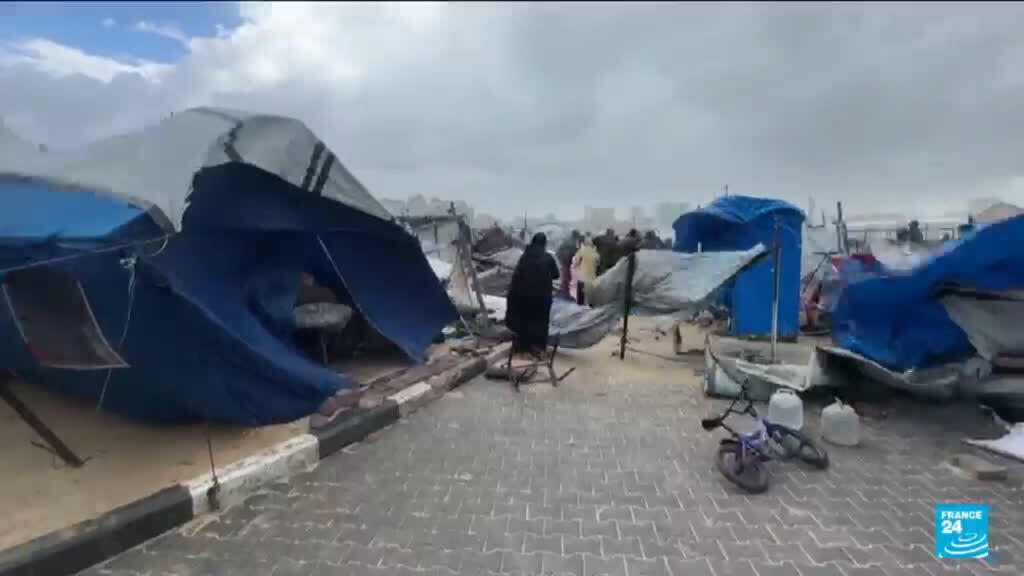
Gaza: Hypothermia kills 5 as blockade hinders aid
World_news

Gaza: Hypothermia kills 5 as blockade hinders aid

Despite the ceasefire, conditions in Gaza remain perilous for many residents, with UNICEF reporting that more than 100 children have been killed by military action since the truce began. Large numbers of people are living in makeshift tent camps that offer little protection from harsh weather, while many buildings remain structurally unsafe following Israeli bombardments. On Tuesday, at least four people were killed when a wall collapsed onto their tent in Gaza. Ellen Gainsford reports.

1h
3 min
0
Read Article
Pivot stratégique de Meta : Restructuration chez Reality Labs
Technology

Pivot stratégique de Meta : Restructuration chez Reality Labs

Meta restructure sa division Reality Labs, supprimant environ 1 000 postes. L'entreprise pivote stratégiquement du métavers vers les produits mobiles et portables basés sur l'IA.

1h
5 min
10
Read Article
🎉

You're all caught up!

Check back later for more stories

Retour a l'accueil